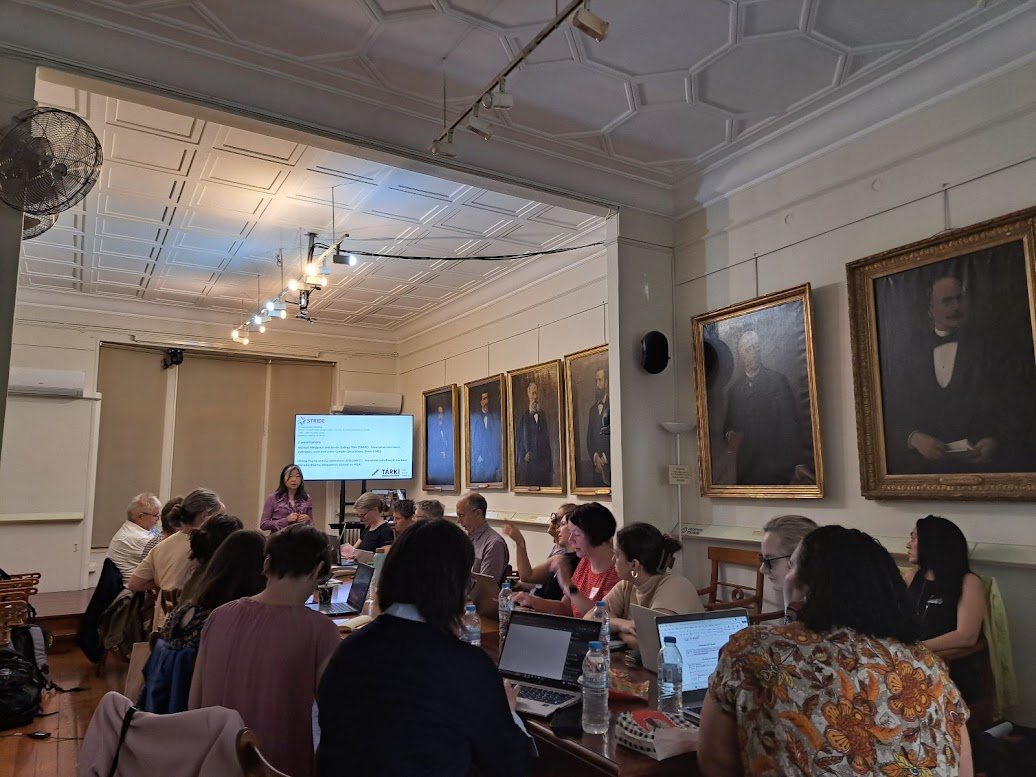
On 12 January 2026, Borbála Lőrincz and Zsófia Tomka from TÁRKI Social Research Institute presented results from STRIDE’s focus on the identification of effective policy initiatives and interventions as part of the ‘What’s Next? New perspectives on (early) childhood education and care’ online lecture series, focusing on giving new perspectives on Early Childhood Education and Care (ECEC).
The discourse surrounding (early) childhood education and care varies significantly across different countries, influenced by diverse historical developments, organisational structures, and social and educational policy frameworks. Nonetheless, commonalities can be identified within scientific discussions.
In this context, the international lecture series invites researchers to present and discuss contemporary research approaches related to (early) childhood education and care. The goal is to provide fresh perspectives and enhance ongoing debates in the field of childhood studies.
The lecture series is organised by a team of researchers representing the University of Hildesheim, the University of Bielefeld, and the Institute for Theory and Empiricism of Social Questions (ITES)
The online lecture series also examines the increasing national and authoritarian trends in Early Childhood Education and Care (ECEC). Borbála Lőrincz and Zsófia Tomka presented their work-in-progress paper, which aims to answer the research question: ‘What conditions and facilitating factors allowed the introduction of an equalising policy in an illiberal system?’. The paper is based on an analysis of prior literature on European ECEC policy and the Hungarian national context, as well as on data collected as part of the STRIDE project: an extensive media analysis of more than 150 online newspaper articles and 8 expert interviews conducted with policymakers and kindergarten teachers. The authors argue that despite their apparent discrepancies, both the EU and the Hungarian national policy context contributed to the feasibility of the equalising policy of mandatory kindergarten from the age of three. Furthermore, due to its general acceptance among the public and professionals alike and relatively low political cost, mandatory kindergarten can “tick the box” of equalising policy requirements in the international (i.e. the EU) arena, while at the same time avoiding in-depth structural reforms at higher levels of education.
The presentation was followed by a vivid discussion. Members of the audience asked questions regarding the ideological aspects of ECEC in Hungary, the pedagogical approaches and structural characteristics of kindergartens, as well as some methodological considerations of the research, including sampling and respondents’ narratives.