STRIDE report examines trends in educational inequalities and the role of early childhood reforms in Europe
Educational inequalities remain a key challenge across Europe, shaping learning outcomes
and opportunities from an early age. The latest STRIDE report analyses how inequalities in
educational achievement have evolved across Europe and how early childhood education
and care (ECEC) reforms relate to these trends. Drawing on international large-scale
assessment data (TIMSS, PIRLS and PISA), the report provides a comparative overview of
disparities in learning outcomes and reviews 25 years of policy reforms aimed at promoting
equity and inclusion.
Mapping inequalities in educational achievement
The report analyses inequalities across 27 EU Member States, Norway and the United
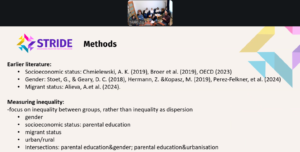
Kingdom, focusing on differences in achievement by parental education, gender, migrant
background and urbanisation.
Findings show that socio-economic background remains the strongest and most persistent
driver of inequality, particularly in mathematics, with gaps often widening by lower
secondary level.
The report also highlights that:
• gender inequalities remain relatively small, with boys performing better in
mathematics and girls in reading;
• migrant-related disparities persist, especially in reading at age 15;
• urban–rural differences are generally moderate but can increase over time.
An intersectional perspective
The report adopts an intersectional approach, showing how multiple forms of disadvantage
interact. Students from lower-educated families, particularly when combined with other
factors such as gender or location, often face compounded barriers and continue to perform
below average in many countries.
25 years of ECEC reforms
The report reviews reforms implemented between 2004 and 2018, focusing on policies that
expand access to early childhood education and strengthen equity.
Across Europe, reforms include:
- free or compulsory preschool provision;
- legal entitlement to ECEC places;
- income-based fee regulation;
- targeted support for disadvantaged groups;
- language and inclusion measures;
- investments in capacity and quality.
These developments reflect the growing recognition of early childhood education as a key
lever for reducing inequalities.
Do reforms reduce inequality?
The analysis combines trend data with multilevel modelling to assess whether ECEC access
reforms are associated with changes in inequality.
Findings suggest that while reforms improve overall educational outcomes, they do not
consistently reduce socio-economic inequalities. In many cases, students from higher-
educated family backgrounds benefit more, limiting the equalising effect of these policies.
Expanding access is not enough
Complementary STRIDE research shows that increasing ECEC participation can reduce
inequalities only when expansion also narrows participation gaps between socio-economic
groups.
This highlights that access alone is insufficient. The impact of early childhood education
depends on equitable participation, quality provision and targeted support for
disadvantaged learners.
Supporting evidence-informed policymaking
Overall, the report shows that educational inequalities remain persistent across Europe and
often emerge early. While early childhood policies can improve outcomes, their contribution
to equity depends on how effectively they reach those most in need.
By linking comparative data with policy developments, the report provides valuable insights
for policymakers, researchers and practitioners working towards more inclusive and
equitable education and training systems.