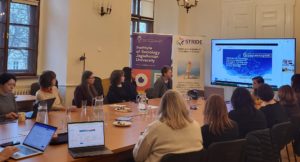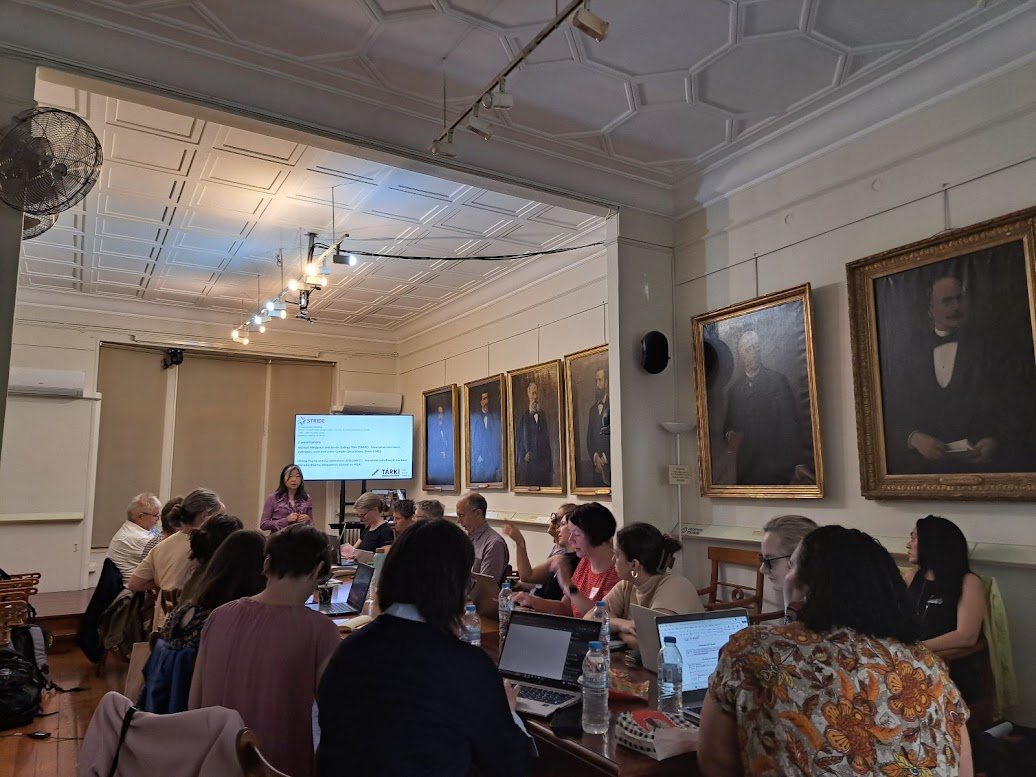
From the 1st to the 4th of December, the STRIDE team met in Aarhus, Denmark. It was a week full of events that served not only to share the results of STRIDE, but also to help us continue and improve our ongoing work.
The first public event began on Tuesday morning with a welcome to the VIA University College facilities for STRIDE members, sister project representatives and relevant stakeholders, where they were updated on the project’s progress. This began with an analysis of reforms addressing inequalities in EU countries (as well as Norway and the UK) over the past 25 years. The main findings of the presentation were that there is a clear absence of reforms that explicitly tackle mental health or LGBTQ+ issues and that the top-down approach is overused, resulting in a lack of local involvement in the design and implementation of these reforms.
Later, another presentation on the work on existing trends in educational achievement inequalities in Europe. They highlighted that, amongst their findings, there is strong evidence that increasing preschool enrolment does not lead to a decrease in educational inequalities in schools.
To conclude the morning session, project partners discussed their studies in five countries (Hungary, Denmark, UK, Norway and Poland), which compared the long-term effects of early childhood education policies. They concluded that reforms can contribute to reducing inequalities, but their effectiveness is strongly impacted by the context in which they are created and implemented. They also highlighted that universal measures create an acceptable framework, but are not enough; targeted support is also needed to address inequalities. Following on from earlier presentations, they also emphasised the importance of considering the local level and context when designing and applying these reforms.
The day continued with the main public event: the Policy Forum. Here, project partners, present stakeholders and representatives of sister projects discussed the ongoing challenges of translating research into educational policy. This was followed by a presentation of the preliminary view of the upcoming STRIDE map and the current findings of the sister projects. Next, there was a roundtable discussion with representatives from public authorities, civil society, and researchers. Finally, participants were divided into small groups according to their areas of expertise to improve future policies, discuss common findings amongst projects, and determine future policy engagement and impact.
The main outcome of this event was the evident mismatch in timelines between academic research and policy action. It was argued that, while policy has very short windows of opportunity for influence, the longer timeline of academic research makes positive relations and influence very difficult. Another significant challenge is that researchers face when translating their findings into accessible communication for policymakers, particularly given that research findings are often highly context-specific, which can lead to different results when applied in different cases.
The second day began with a workshop involving stakeholders from Denmark and Norway, as well as policy experts and international advisors from the project. The workshop was held within the framework of the upcoming toolbox for effective policymaking that the project will release. The objective was to understand the needs and practices of the primary user groups and adapt the toolbox to the end user to increase its effectiveness.
The meetings concluded with further presentations from the project partners regarding their work and the next steps, which will soon be published.